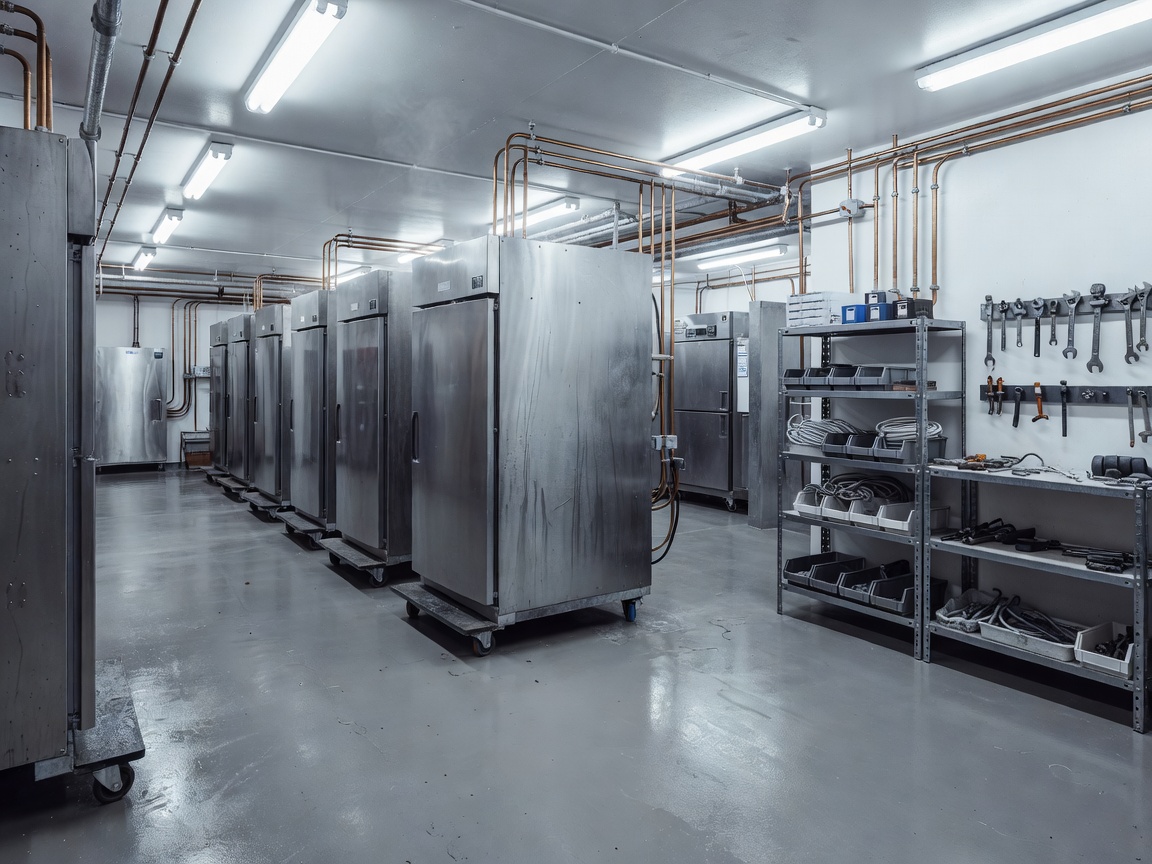
Inspect before failure becomes the plan.
A maintenance routine should follow room use, equipment design, manufacturer guidance and operating environment. It normally combines regular visual checks with specialist service intervals. Records should show the date, observation, action, responsible person and follow-up status.
Door seals, hinges and closers deserve frequent attention. A damaged seal or door that does not close fully increases warm-air entry and can alter frost or condensation patterns. Panels, corners and floor junctions should be observed for damage, gaps or moisture. Repairs must use suitable materials and competent personnel.
Watch the refrigeration system.
Operators do not need to dismantle equipment to notice condition changes. Unusual noise, changed run behaviour, repeated alarms, visible damage, heavy frost or unexpected temperature drift should be recorded and escalated. Evaporators and condensers need clear, clean surroundings. Access must remain safe for qualified service personnel.
Do not open refrigerant circuits, work on live electrical systems, dismantle compressors or bypass protection. Those tasks require appropriately qualified professionals and manufacturer procedures.
Condensation and drainage are signals.
Water around doors, floors or drain points may indicate a cleaning issue, a blocked route, a temperature condition or a building detail requiring review. Frost accumulation can have several causes. Avoid treating symptoms with improvised scraping or control changes. Record the location, timing and operating context, then escalate appropriately.
Preventative versus reactive work.
Reactive maintenance restores operation after a fault. Preventative maintenance reduces uncertainty through planned checks and scheduled service. Both have a place. A practical programme defines what operators observe daily, what supervisors review periodically and what specialists service. Cleaning coordination matters because cleaning access, wet processes and product protection must be considered together.
Key checks
- Door seals, hinges and closers operate as intended.
- Panels, floors and penetrations show no unresolved damage.
- Drainage and condensation observations are recorded.
- Frost, alarms and temperature trends are reviewed.
- Qualified personnel handle refrigeration and electrical work.
What to plan
Set an inspection calendar around harvest, peak loading and quieter service windows. Define escalation thresholds without inventing universal values. Keep service reports with equipment information and room records. Compare the cost of planned downtime with the risk of an unplanned interruption. A good maintenance record is useful evidence for the next inspection, seasonal preparation and operational review.
Maintenance is not only repair. It is the operating memory of the room.